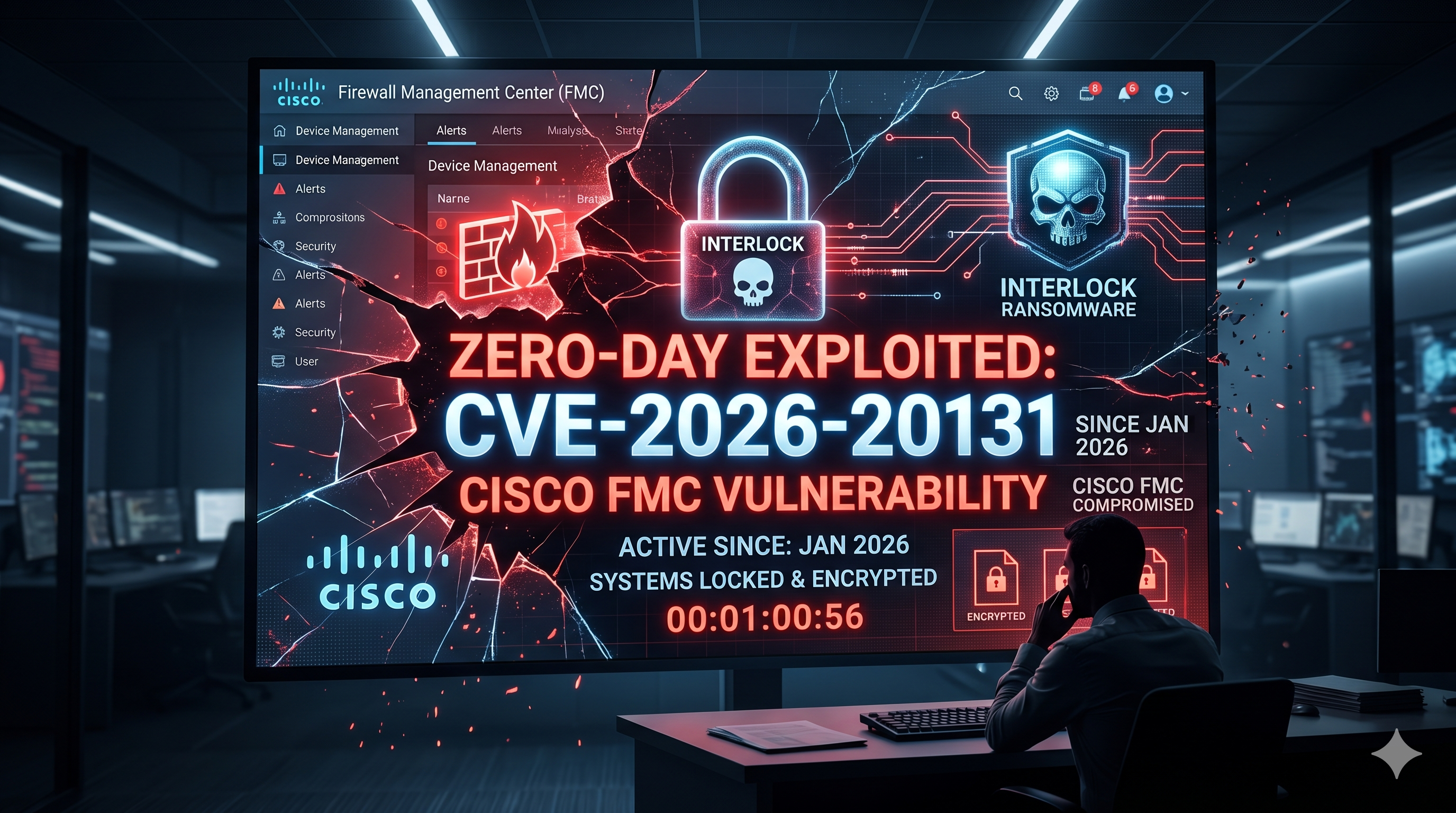
A single unauthenticated HTTP request gave Interlock ransomware root on the box that controls your firewalls. No credentials, no user interaction, no second stage to bypass auth. CVE-2026-20131 is a CVSS 10.0 deserialization flaw in the Cisco Secure Firewall Management Center (FMC) web interface — and Interlock was already exploiting it on January 26, 2026, 36 days before Cisco had a patch or an advisory.
That window matters because FMC is not an endpoint. It is the management plane: firewall policy, NAT rules, VPN configuration, and every connected Firepower Threat Defense device. Compromise it and the attacker doesn't just have a foothold — they have your perimeter's rulebook.
When the box that enforces your network policy is the box that gets owned, "defense in depth" collapses to a single point of failure.
The Vulnerability: Insecure Deserialization, the Classic Root Cause
CVE-2026-20131 is a CWE-502 insecure deserialization flaw in the FMC web-based management interface. The interface accepts a serialized Java object from an untrusted source and deserializes it without sufficient validation. A crafted byte stream triggers a gadget chain — a sequence of existing Java library methods chained to execute arbitrary OS commands. In FMC's case, the deserializing process runs as root.
There are no mitigating prerequisites. The CVSS vector spells out why this scores a perfect 10.0:
| Metric | Value | What it means |
|---|---|---|
| Attack Vector (AV) | Network | Exploitable remotely over the wire |
| Attack Complexity (AC) | Low | No special conditions or timing required |
| Privileges Required (PR) | None | No authentication needed |
| User Interaction (UI) | None | No victim action required |
| Scope (S) | Changed | Impact crosses a security boundary |
| Confidentiality (C) | High | Full information disclosure |
| Integrity (I) | High | Full system modification |
| Availability (A) | High | Full system disruption |
Full vector: CVSS:3.1/AV:N/AC:L/PR:N/UI:N/S:C/C:H/I:H/A:H.
Affected Versions
Per NVD and Cisco's March 4, 2026 advisory, the following Cisco Secure FMC Software releases are vulnerable:
- 7.4.x — 7.4.0, 7.4.1, 7.4.1.1
- 7.3.x — 7.3.0, 7.3.1, 7.3.1.1, 7.3.1.2
- 7.2.x — 7.2.0 through 7.2.5.2
- 7.1.x — 7.1.0 through 7.1.0.3
- 7.0.x — 7.0.5, 7.0.6, 7.0.6.1 and earlier
Who Is Interlock
Interlock surfaced in September 2024 running a double-extortion model — encrypting victim data while exfiltrating it to a Tor-hosted leak portal. Notably, Interlock does not run a Ransomware-as-a-Service program, which makes it a tighter operation with more consistent TTPs than the typical affiliate-driven crew.
Confirmed victims before the FMC campaign include DaVita, Kettering Health, the Texas Tech University System, the City of Saint Paul, and multiple UK universities. The targeting pattern is deliberate: healthcare, education, government, manufacturing, engineering, architecture, and construction — sectors that run large Cisco firewall estates, hold high-value PII/PHI/IP, and face regulatory pressure that raises their willingness to pay. Operational-timezone analysis places the group in UTC+3 (75–80% confidence), with peak activity 12:00–18:00 UTC+3, consistent with an Eastern European or Middle Eastern base.
The 36-Day Zero-Day Window
Amazon's threat intelligence team, using their MadPot honeypot infrastructure, confirmed the January 26 start and noted Interlock had roughly a week to hit initial targets before the broader defender community had any signal at all.
| Date | Event |
|---|---|
| Jan 26, 2026 | Interlock begins zero-day exploitation of CVE-2026-20131 |
| Feb–Mar 2026 | Silent exploitation continues; no public patch or advisory |
| Mar 4, 2026 | Cisco discloses CVE-2026-20131 and ships fixed software |
| Mar 19, 2026 | CISA adds the CVE to the KEV Catalog |
| Mar 22, 2026 | CISA-mandated remediation deadline for federal civilian agencies |
| Mar 25, 2026 | NVD last-modified date reflecting updated exploitation confirmation |
Recorded Future's March 2026 CVE Landscape flagged CVE-2026-20131 among 31 high-impact vulnerabilities that month, and named Interlock's campaign the highest-severity active exploitation of the period.
The Kill Chain
Stage 1 — Initial Access via CVE-2026-20131
- Reconnaissance — identify internet-exposed FMC instances, typically on port 443 or 8305.
- Exploit delivery — an HTTP POST to a vulnerable FMC endpoint carrying a crafted serialized Java object.
- Gadget-chain execution — the FMC Java runtime deserializes the object and runs OS commands as root.
- Payload staging — two embedded URLs in the payload deliver configuration data and confirm success via HTTP PUT.
- Persistence staging — a malicious ELF binary is fetched and executed from attacker infrastructure.
Confirmed exploit source IPs: 206.251.239.164 (January 2026), 199.217.98.153 and 89.46.237.33 (March 2026).
Stage 2 — Post-Exploitation Toolkit
- JavaScript RAT — obfuscated implant using RC4 with per-message 16-byte random keys over WebSocket; shell, file transfer, and SOCKS5 proxy.
- Java RAT — functionally equivalent, built on GlassFish/Grizzly/Tyrus libraries; both implants self-update and self-delete.
- Memory-resident Java webshell — fileless, AES-128 encrypted (key derived from the MD5 of
geckoformboundary99fec155ea301140cbe26faf55ed2f40); never touches disk. - Infrastructure — a TCP beacon on port
45588and a HAProxy relay script that turns compromised Linux hosts into C2 relays, deleting logs every five minutes. - Legitimate tool abuse — ConnectWise ScreenConnect as backup persistence, the Certify AD CS exploitation tool, and Volatility repurposed for memory/credential analysis.
Stage 3 — Lateral Movement and Recon
Post-access, Interlock runs PowerShell enumeration of Windows hosts: OS and hardware, services and installed software, browser artifacts (Chrome/Edge/Firefox credential stores and cookies), active connections and ARP tables, RDP event logs, process lists, and registry contents. Data is staged to hostname-based network shares (e.g. \\JK-DC2\Temp), ZIP-compressed, and exfiltrated. The Lumma and Berserk infostealers add browser-credential harvesting.
Stage 4 — Double Extortion
Encryption plus threatened publication on the Tor leak portal, with ransom notes leaning on regulatory-violation threats. The ransom-communication portal and screen-locker binary hash are in the IOC appendix below.
MITRE ATT&CK Mapping
| Tactic | Technique | Observed behavior |
|---|---|---|
| Initial Access | T1190 Exploit Public-Facing Application | Java deserialization against FMC web interface |
| Execution | T1059.001 PowerShell | Recon scripts post-compromise |
| Execution | T1059.007 JavaScript | RC4-encrypted WebSocket RAT |
| Persistence | T1505.003 Web Shell | Fileless AES-128 Java webshell |
| Persistence | T1053 Scheduled Task/Job | Task creation on Windows hosts |
| Persistence | T1078 Valid Accounts | Reuse of harvested credentials |
| Defense Evasion | T1027 Obfuscated Files or Information | RC4/AES implants, obfuscated JS |
| Defense Evasion | T1070 Indicator Removal | HAProxy relay deletes logs every 5 min |
| Defense Evasion | T1036 Masquerading | ScreenConnect as a legitimate tool |
| Credential Access | T1555 Credentials from Password Stores | Lumma/Berserk browser stealers |
| Discovery | T1082 / T1518 / T1049 / T1057 / T1033 / T1087 / T1012 / T1040 | Host, software, connection, process, user, account, registry, ARP enumeration |
| Lateral Movement | T1021.001 RDP | Movement with harvested credentials |
| Lateral Movement | T1021.002 SMB/Admin Shares | Staging to \\hostname\Temp |
| Collection | T1005 / T1010 | Local data and application-window discovery |
| C2 | T1573.001 Encrypted Channel | RC4 and AES-128 C2 |
| C2 | T1090.001 Internal Proxy | HAProxy relay on Linux hosts |
| Exfiltration | T1020 / T1041 | Automated ZIP staging, exfil over C2 |
| Impact | T1486 Data Encrypted for Impact | File encryption |
| Impact | T1490 Inhibit System Recovery | Shadow copy deletion |
Defense and Detection
Patch It Like an Emergency
Cisco shipped fixed software on March 4, 2026. With confirmed exploitation since January 26 and a KEV listing, treat this as emergency remediation regardless of maintenance windows, and upgrade to the latest fixed release — not the minimum fixed version. Use your vulnerability-management and asset-inventory tooling to find every unpatched FMC instance and rank it critical.
Get FMC Off the Internet
The FMC management interface should never face the public internet. Cisco's advisory is explicit: restrict the web interface to trusted management networks. If you find an exposed instance:
- Place it behind a VPN or jump host immediately.
- Restrict source IPs via ACLs to known management workstations.
- Enforce MFA for all FMC administrative access.
- Audit your perimeter, load balancer / ADC, and reverse-proxy logs for any external traffic to FMC management ports (
443,8305).
Detect the Exploit at the Web/Network Layer
Frame these as rules in your WAF and perimeter logs — the field names will differ by vendor, but the behavior is universal:
- Alert on requests to FMC management paths carrying serialized Java object indicators: the
ac ed 00 05("aced0005") magic bytes,srmarkers, orjava.*class references in request bodies. - Flag the anomalous exploit User-Agent —
Mozilla/5.0 (Windows NT 10.0; Win64; x64; rv:136.0) Gecko/20100101 Firefox/136.0— when it originates from non-browser infrastructure. - Block the known exploit source IPs (
206.251.239.164,199.217.98.153,89.46.237.33). - Watch inbound POST/PUT requests with
Content-Type: application/octet-streamorapplication/x-java-serialized-objectto management paths. - Push WAF rules that block serialized Java object patterns at the HTTP layer as defense-in-depth, even after patching.
- Alert on repeated 5xx errors from a single source against management paths — deserialization exploits often generate error-producing probes before they land.
Detect the Post-Exploitation at the Endpoint
These belong in your EDR/XDR platform and host telemetry:
# Linux — suspicious child of an FMC web service
parent IN (httpd, java, tomcat-worker) AND child IN (curl, wget, bash)
  AND new_file_path IN (/tmp/, /dev/shm/, <world-writable>)
  AND time_since_fmc_activity < 60s
  → likely ELF staging after exploitation

# Linux — egress from an FMC server process to known C2
src_process = fmc_web_service
dst_ip IN (144.172.94.59, 199.217.99.121, 188.245.41.78,
           144.172.110.106, 95.217.22.175, 37.27.244.222)
  OR dst_port = 45588
  → C2 beacon / data egress
Additional behaviors to alert on:
- DNS queries for the C2 domains in the appendix (
cherryberry.click,ms-server-default.com,os-update-server.*, etc.). - TLS fingerprints matching the JA3/JA4 values below.
- File writes — ZIP archives in
\\hostname\TemporC:\Windows\Temp(staging), plus the Certify and screen-locker hashes. - Ransomware behavior and Volume Shadow Copy deletion — run these detections in prevent mode, not detect-only.
- Anomalous RDP authentications and lateral movement following recon spikes.
- Scheduled task creation by non-standard parent processes.
- Unexpected ConnectWise ScreenConnect installs — treat any undocumented new install as backdoor deployment.
Why This Keeps Happening
CVE-2026-20131 is part of an accelerating pattern: ransomware crews acquiring and weaponizing zero-days against security infrastructure itself — firewalls, VPN concentrators, management consoles. It echoes CVE-2023-20269 (Cisco ASA/FTD, exploited by Akira and LockBit), CVE-2024-3400 (PAN-OS), and CVE-2025-0282 (Ivanti Connect Secure).
Security infrastructure is a high-value target for three structural reasons: compromise grants network-wide visibility and movement; responsible-disclosure timelines create exploitable windows between discovery and patch; and defenders rarely have EDR/XDR coverage on network appliances the way they do on endpoints.
Your endpoints are watched. Your firewall manager probably isn't. Attackers know which gap is wider.
Interlock's leap from a 2024 commodity operator to a zero-day-capable actor — with custom RATs, fileless webshells, log-deletion tradecraft, and fallback persistence — is the story here. IBM X-Force's attribution of Slopoly, an AI-generated malware strain, to Interlock suggests AI-assisted development is now in their pipeline. And CWE-502 itself remains a chronic enterprise wound a decade after Frohoff and Lawrence's 2015 disclosure: Java serialization is woven into legacy apps, safe fixes take real engineering, and toolkits like ysoserial keep the exploitation bar low.
Action Checklist
Immediate (0–72 hours)
- Patch every Cisco Secure FMC instance to a fixed release; treat as emergency maintenance.
- Audit exposure — confirm no FMC management interface (
443,8305) is externally reachable. - Hunt IOCs — sweep Linux/Windows/macOS hosts for the C2 IPs/domains, the Certify and screen-locker hashes, and the JA3/JA4 fingerprints.
- Update WAF rules — push Java deserialization blocks and exploit source-IP blocks.
Short-term (1–4 weeks)
- Retrospective log review — examine perimeter/WAF logs for Jan 26 – Mar 22, 2026 for historical compromise warranting IR.
- Segmentation review — FMC reachable only from dedicated management VLANs behind MFA-protected jump hosts.
- Rotate credentials — if FMC was exposed during the zero-day window, rotate everything reachable from it: managed firewall creds, LDAP/AD service accounts, API keys.
- Harden endpoint policy — ransomware-behavior and shadow-copy-deletion detections in prevention mode.
- Monitor task/service creation by non-standard parents.
Strategic (1–3 months)
- Reduce security-infra attack surface — audit every internet-exposed management interface (SIEM, EDR consoles, firewall management, VPN portals); enforce VPN/zero-trust gateway plus MFA plus IP allowlisting.
- Java deserialization controls — audit whether serialization is required; apply
ObjectInputFilteror move to JSON/protobuf. - Threat-intel integration — ingest Interlock C2 indicators into WAF blocklists and EDR feeds.
- IR runbooks for management-plane compromise — the response differs from endpoint ransomware because the adversary may control firewall policy itself.
IOC Appendix
IP Addresses
| Indicator | Role | First seen |
|---|---|---|
206.251.239.164 | Exploit source | January 2026 |
199.217.98.153 | Exploit source | March 2026 |
89.46.237.33 | Exploit source | March 2026 |
144.172.94.59 | C2 / backend | 2026 |
199.217.99.121 | C2 fallback | 2026 |
188.245.41.78 | C2 fallback | 2026 |
144.172.110.106 | Backend C2 | 2026 |
95.217.22.175 | Backend C2 | 2026 |
37.27.244.222 | Staging host | 2026 |
Domains
| Indicator | Role |
|---|---|
cherryberry.click | Exploit / staging |
ms-server-default.com | Exploit / staging |
initialize-configs.com | Exploit / staging |
ms-global.first-update-server.com | Exploit / staging |
ms-sql-auth.com | Exploit / staging |
kolonialeru.com | Exploit / staging |
sclair.it.com | Exploit / staging |
browser-updater.com / browser-updater.live | C2 |
os-update-server.com / .org / .live / .top | C2 |
File Hashes (SHA-256)
| Hash | Artifact |
|---|---|
d1caa376cb45b6a1eb3a45c5633c5ef75f7466b8601ed72c8022a8b3f6c1f3be | Certify (AD CS exploitation) |
6c8efbcef3af80a574cb2aa2224c145bb2e37c2f3d3f091571708288ceb22d5f | Screen locker binary |
TLS Fingerprints
| Type | Value |
|---|---|
| JA3 | b885946e72ad51dca6c70abc2f773506 |
| JA3 | f80d3d09f61892c5846c854dd84ac403 |
| JA4 | t13i1811h1_85036bcba153_b26ce05bbdd6 |
| JA4 | t13i4311h1_c7886603b240_b26ce05bbdd6 |
Network and Other Indicators
- TCP port
45588— Interlock C2 beacon listener. - User-Agent —
Mozilla/5.0 (Windows NT 10.0; Win64; x64; rv:136.0) Gecko/20100101 Firefox/136.0(exploit and implant traffic). - AES-128 key seed —
geckoformboundary99fec155ea301140cbe26faf55ed2f40(Java webshell). - Tor portal —
ebhmkoohccl45qesdbvrjqtyro2hmhkmh6vkyfyjjzfllm3ix72aqaid.onion/chat.php(ransom communication).
The Takeaway
The lesson of CVE-2026-20131 isn't "patch your firewalls" — though you should, today. It's that the device enforcing your network policy is now a primary ransomware target, and it almost certainly has thinner telemetry than the laptops it protects. Close that gap before the next zero-day finds it.
If you're not sure whether your management-plane infrastructure is exposed — or whether you have detection coverage for behavior like the kill chain above — that's exactly the kind of question our team helps answer. For a faster line, reach us at support@eagleeye-sec.com.
References
- NVD — CVE-2026-20131
- AWS Security Blog — Interlock campaign targeting enterprise firewalls
- BleepingComputer — Interlock exploited Secure FMC flaw since January
- Help Net Security — Cisco FMC flaw exploited weeks before patch
- The Hacker News — Interlock exploits Cisco FMC zero-day for root
- Recorded Future — March 2026 CVE Landscape
- The Record — Interlock exploited Cisco firewall zero-day before disclosure
- Security Affairs — Interlock exploiting CVE-2026-20131 36 days before disclosure
- CISA — #StopRansomware: Interlock (AA25-203A)
- Hive Pro — Interlock exploits critical Cisco Secure FMC flaw
- Horizon3.ai — CVE-2026-20131 Cisco FMC RCE
- FortiGuard Labs — Interlock Ransomware: New Techniques, Same Old Tricks
- Dark Reading — Interlock Targets Cisco Enterprise Firewalls
- SC World — Interlock targeting of max-severity Cisco FMC zero-day

EagleEye Security Team
Threat Intelligence — writing on threat intelligence, detections, and agentic security operations.